How to Calculate Your Net Worth in Norway (Property, Pension, Debt & Investments)
Learn how to calculate your net worth in Norway. This guide covers tracking property equity, Norwegian pensions, debt, and investments for a complete picture.
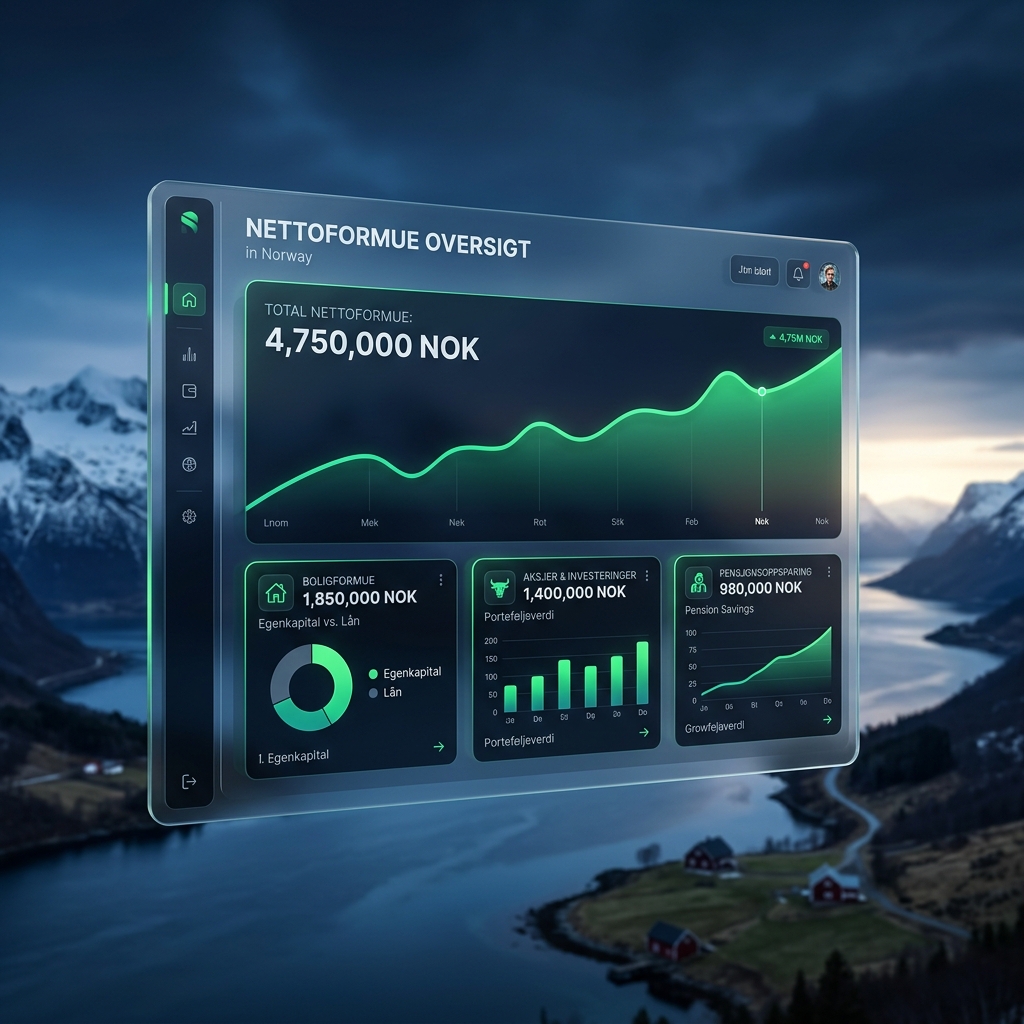
Quick Answer:
Net worth is the total value of everything you own (assets) minus everything you owe (liabilities). To calculate your net worth in Norway, you need to sum up your property equity, investment accounts, Norwegian pensions (OTP, IPS, AFP), cash, and vehicles, then subtract all outstanding debt. According to SSB (Statistics Norway), the median wealth for Norwegian households is heavily tied to real estate, meaning you must look far beyond just your liquid bank accounts to see the full picture.
Most Norwegian investors know their Nordnet or DNB account balance. Fewer know their actual net worth.
Those are very different numbers, and the gap between them is often larger than people expect.
Norwegian wealth is notoriously fragmented. It is scattered across property, multiple pension accounts, cash deposits, different investment brokers, and vehicles. When people only track one part of the picture, like their stock portfolio, they make financial decisions based on incomplete data.
This guide walks through how to calculate net worth in Norway accurately. We will cover every major asset class, in logical order, with practical Norwegian examples throughout.
Why Your Brokerage Balance Is Not Your Net Worth
Your investment portfolio is just one slice of your total financial picture.
Consider a typical scenario: a 38-year-old professional in Oslo with an investment portfolio worth NOK 800,000. That sounds like a solid position. But look at the fragmented wealth elsewhere:
- Apartment purchased for NOK 4.2M in 2018, currently estimated at NOK 5.8M
- Remaining mortgage: NOK 3.1M
- Property equity: NOK 2.7M
- OTP pension value: NOK 1.1M
- Cash in savings accounts: NOK 150,000
- Car market value: NOK 180,000
Total net worth: approximately NOK 4.93M.
The stock portfolio (the number this person probably checks the most) represents just 16% of their net worth. The other 84% was sitting elsewhere, uncounted.
Step 1: Calculate Your Property Equity
If you own property in Norway, this is likely your largest asset. Here is how to calculate the equity:
Property equity = Current market value − Outstanding mortgage balance
To find the current market value, check Eiendomsverdi.no, a property valuation tool often used by Norwegian banks. Keep in mind that online property valuations are estimates based on local market trends. For a precise number, you would need to request an e-takst or formal valuation (verdivurdering) from a local estate agent.
Your outstanding mortgage balance can be found in your DNB, Nordea, or Sbanken online banking portal.
If you have multiple properties, like a cabin (hytte) or a rental unit, calculate the equity for each separately.
Future Internal Link Opportunity: Property Equity Calculator
Step 2: Add Your Investment Accounts
Many Norwegians use multiple brokers. You need to sum up the current market value of all your holdings.
List every brokerage account you hold:
- Nordnet (often used for Nordic stocks and mutual funds)
- DNB or other traditional bank brokers
- Pareto Securities or Saxo Bank
- International brokers like Interactive Brokers
Add up the total value of your stocks, ETFs, mutual funds, and uninvested cash sitting in these accounts.
Step 3: Add Your Norwegian Pension Value
Norwegian pension is split across several types, and most employees have more than one. These are assets that will fund your retirement, so they belong in your net worth calculation.
OTP (obligatorisk tjenestepensjon) is the mandatory workplace pension your employer contributes to. Most Norwegians have this through providers like Storebrand, KLP, or DNB Liv. You can log in to your provider's portal or check Norsk Pensjon to see a consolidated view of your private and occupational pensions.
IPS (individuell pensjonssparing) is an optional private pension savings account. If you have one, it is tracked separately from your OTP.
AFP (avtalefestet pensjon) is an early retirement supplement available to employees in qualifying industries. Rules regarding qualification and payout can be found at NAV.no.
Add the current balance of each defined contribution pension account.
Future Internal Link Opportunity: Norwegian Pension Guide
Step 4: Add Cash and Savings
List every bank account you hold:
- Main current account
- High-yield savings accounts
- Buffer accounts
- Foreign currency accounts
The balance on each account is part of your net worth. Do not forget accounts you opened for specific purposes (like a holiday fund or a kids' savings account) and then stopped actively monitoring. According to Finanstilsynet, Norwegian households still hold a significant portion of their liquid wealth in bank deposits.
Step 5: Count Your Vehicles
Vehicles lose value over time, but they still have a resale value today.
Depreciation varies significantly by vehicle type, brand, and usage. Instead of using a fixed depreciation percentage, the most reliable method is to check Finn.no for comparable listings of the same make, model, year, and mileage.
If you have an outstanding vehicle loan (billån), subtract that balance from the market value to find your vehicle equity.
Step 6: Include Unlisted Investments
If you have invested in private companies, like a startup or shares through a crowdfunding platform, these count as assets.
Valuing unlisted shares is more complex than listed stocks. A reasonable approach is to use the most recent funding round or valuation as a proxy. If a company has gone into administration or you believe the shares are worthless, write them down to zero to keep your net worth calculation realistic.
Step 7: Subtract All Remaining Debt
You have already subtracted your mortgage and vehicle loan in the steps above. Now add up any remaining debt:
- Student loans (Lånekassen)
- Consumer credit or credit card balances
- Personal loans (forbrukslån)
- Margin loans or portfolio credit
Your total net worth is:
Net worth = (All assets) − (All liabilities)
Why Wealth Tracking Matters
Tracking your portfolio tells you how your stocks are performing. Tracking your net worth tells you whether you are actually building wealth overall.
Knowing your net worth helps you:
- Understand your true financial position.
- See your asset allocation clearly (you may be far more exposed to residential property than you realised).
- Track progress year over year.
- Make informed decisions about where to allocate new capital.
The Manual Tracking Problem
The calculation above is straightforward in theory. In practice, pulling numbers from Nordnet, your bank, Eiendomsverdi, Norsk Pensjon, and Finn.no, and keeping them updated, is a time-consuming chore.
Wealth in Norway is highly fragmented. Most people build a spreadsheet once, let the data go stale, and eventually abandon it.
If you want a more sustainable way to manage this, you might consider using dedicated software. Netfolio is a wealth tracking platform built specifically for Norwegian investors. It is designed to pull this fragmented picture together, supporting Norwegian pension types, property equity, unlisted investments, and multiple brokerage accounts in one unified dashboard.
Whether you use a spreadsheet or software, the most important step is simply starting to measure it. You can explore Netfolio here.
Frequently Asked Questions (FAQ)
What is considered a good net worth in Norway?
"Good" is highly subjective and depends entirely on your age and financial goals. According to SSB, median household wealth is heavily influenced by age and whether the household owns their primary residence.
Future Internal Link Opportunity: Net Worth by Age in Norway
Should pensions be included in net worth?
Yes. Defined contribution pensions (like OTP and IPS) are assets that belong to you and will fund your retirement. Excluding them gives an artificially low view of your financial health.
Do I include my primary residence?
Yes. Your primary residence is an asset with a market value. However, you only include the equity (the market value minus your outstanding mortgage).
Should I include my car?
Yes, but only its current, depreciated resale value on the open market, minus any outstanding car loan.
How often should I calculate net worth?
For most people, updating a manual net worth spreadsheet quarterly or semi-annually is sufficient. Checking too often can lead to unnecessary stress over short-term market fluctuations. If you use automated wealth tracking software, the numbers update continuously without manual effort.
Future Internal Link Opportunity: Wealth Tax (Formuesskatt)
Ready to take control?
Start tracking your global wealth in one clear picture today.